Evidence Based


 Updated on:
28.08.2025
Updated on:
28.08.2025
 6 min read
[medical_disclaimer title=”Medical Disclaimer”]The medicines listed on this website are only there to give you knowledge. Just because they are on the list doesn’t mean that anyone will be given them; in the end, treatment decisions are up to the healthcare workers. The medicines on this list are not all of them. Doctors may recommend other drugs, even ones that don’t contain stimulants, depending on the patient’s specific health needs and circumstances.[/medical_disclaimer]
One common sleep problem that negatively impacts sleep patterns is insomnia . About 10–30% of persons worldwide are affected, and more women than males are diagnosed with it.
When someone has insomnia, they may struggle with one or more symptoms. These might include short sleep durations, difficulties going to sleep and staying asleep through the night, waking up too early, and difficulty falling back asleep. Insomnia impacts a person’s physical and emotional well-being since an adult needs seven to nine hours of sleep every day in order to operate properly.
Physicians advise treating insomnia with a non-pharmacologic intervention as the first line of treatment. These include adopting healthy lifestyles, relaxing methods, and cognitive-behavioral treatment. The doctor may recommend medication, such as Ambien, to treat insomnia if the non-pharmacological approach is ineffective. Let’s read more about this medication and its effectiveness in this post.
The FDA has authorized the prescription drug Ambien for the treatment of insomnia. Zolpidem Tartrate is another generic name for the medication. It is categorized as a GABA agonist that is not benzodiazepine. It helps those who have trouble falling asleep and staying asleep. Short-term insomnia can be effectively treated with Ambien, and the lowest dosage is often recommended.
Because Zolpidem can lead to reliance and tolerance, health guidelines advise using it as a second-line treatment following a psychotherapy trial. It may lead to pharmaceutical abuse in both situations. Because of this, Ambien generics are classified as Schedule IV medicines and are under DEA oversight to reduce the possibility of abuse and dependency.
Ambien promotes and enhances sleep by increasing the action of gamma-aminobutyric acid (GABA) molecules in the brain. The procedure helps someone fall asleep by calming and slowing down brain activity . Both the immediate-release and the extended-release (Ambien CR) forms of Ambien are available.
Immediately after consumption, the immediate-release medication dissolves and helps the patient fall asleep quickly. The expanded form of Zolpidem contains two layers. The first layer dissolves immediately after consumption, promoting rapid slumber. To keep a person sleeping, the second layer progressively disappears.
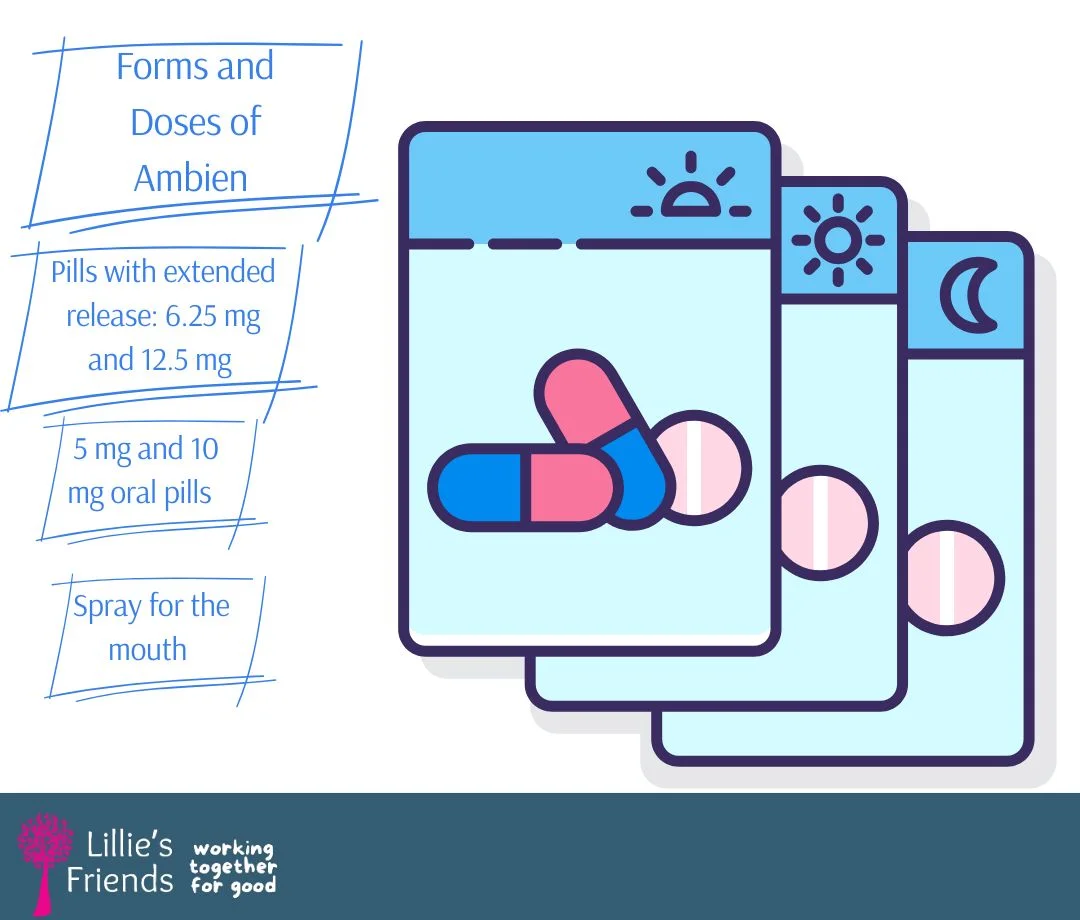
There are three forms of Ambien medication: oral spray, oral tablet, and extended-release pill. While extended-release pills come in 6.25 mg and 12.5 mg strengths, immediate-release medications come in 5 mg and 10 mg tablets. Additionally, it comes as an oral spray that may be sprayed on the tongue and a sublingual tablet that can be placed beneath the tongue. The dose is given in 5 mg or 10 mg tablets, depending on the patient’s sleep quality.
For older adults, 5 mg is the recommended daily amount; for women, this is the starting dose; and for males, it can be either 5 mg or 10 mg. A daily dose of 6.25 mg of the extended-release tablet is recommended, with a maximum dose of 12.5 mg. Seven to eight hours before the scheduled wake-up time, the drug is given just before bed. Ambien slows down its effects; therefore, it is best to avoid taking it with or just after eating.
The only known contraindication to using Ambien to treat insomnia is a known allergy to zolpidem tartrate or any of its other components. Additionally, a person with any of the following conditions should exercise caution when using Zolpidem to treat insomnia unless directed by a physician:
In rare instances, some individuals have had strange side effects from the drug.
For example, once the effects of the drug wear off, some persons do not recall doing the following activities:
Like most drugs, Ambien may have modest adverse effects, some of which may be managed without a prescription.
Some of Zolpidem’s adverse effects are listed below:
Someone should get in touch with a doctor immediately if they encounter any of the following serious symptoms:
The doctor progressively reduces the dosage to avoid withdrawal symptoms. When Zolpidem is abruptly stopped after prolonged usage or high dosages, withdrawal symptoms are likely to occur.
Symptoms of Ambien withdrawal include:
Although there are several safety precautions to be taken when using Ambien, an FDA-approved short-term insomnia drug, it works well. It’s crucial to take medication according to the doctor’s instructions for safety reasons. A health professional should be consulted right away for a review in the event of serious side effects or withdrawal symptoms.