Evidence Based


 Updated on:
29.08.2025
Updated on:
29.08.2025
 5 min read
As your level of worry increases, you may experience various physical anxiety symptoms, such as a racing heart, fast breathing, shaking, or trembling. Additionally, when your stress level decreases, you may feel tired and exhausted throughout your body.
Muscle weakness can exacerbate existing worry and be quite frightening. You may experience overwhelming distress if you are under a lot of stress or concern.
Naturally, if this condition persists, day-to-day functioning may become quite challenging. Furthermore, engaging in physical activity might seem unattainable.
What is the connection between weakness and anxiety? Let’s get into more details about this.
Weakness in the muscles is not a typical sign of anxiousness. Nonetheless, it may occur in combination with other symptoms of a panic attack or when you are extremely tight, pressured, apprehensive, or anxious. It can also occasionally occur in the absence of any triggers. Muscular dystrophy, or increasing muscle weakening, has also been linked to stress problems, including anxiety, according to a study .
It can also be present in different degrees of intensity, ranging from hardly noticeable to quite noticeable. Daily activities may be hampered by this.
When worry is the reason, one or more muscles may feel so weak, numb, heavy, or exhausted that it is difficult to move, relax, or release a group of muscles. Because your muscles aren’t supporting your weight or bodily motions, you could also feel worn out. Anxiety specifically affects the muscles in the hands, arms, neck, chest, stomach, and back. Anxiety-related muscular weakness might resemble signs of more serious conditions, including Parkinson’s disease , amyotrophic lateral sclerosis (ALS), or multiple sclerosis (MS).
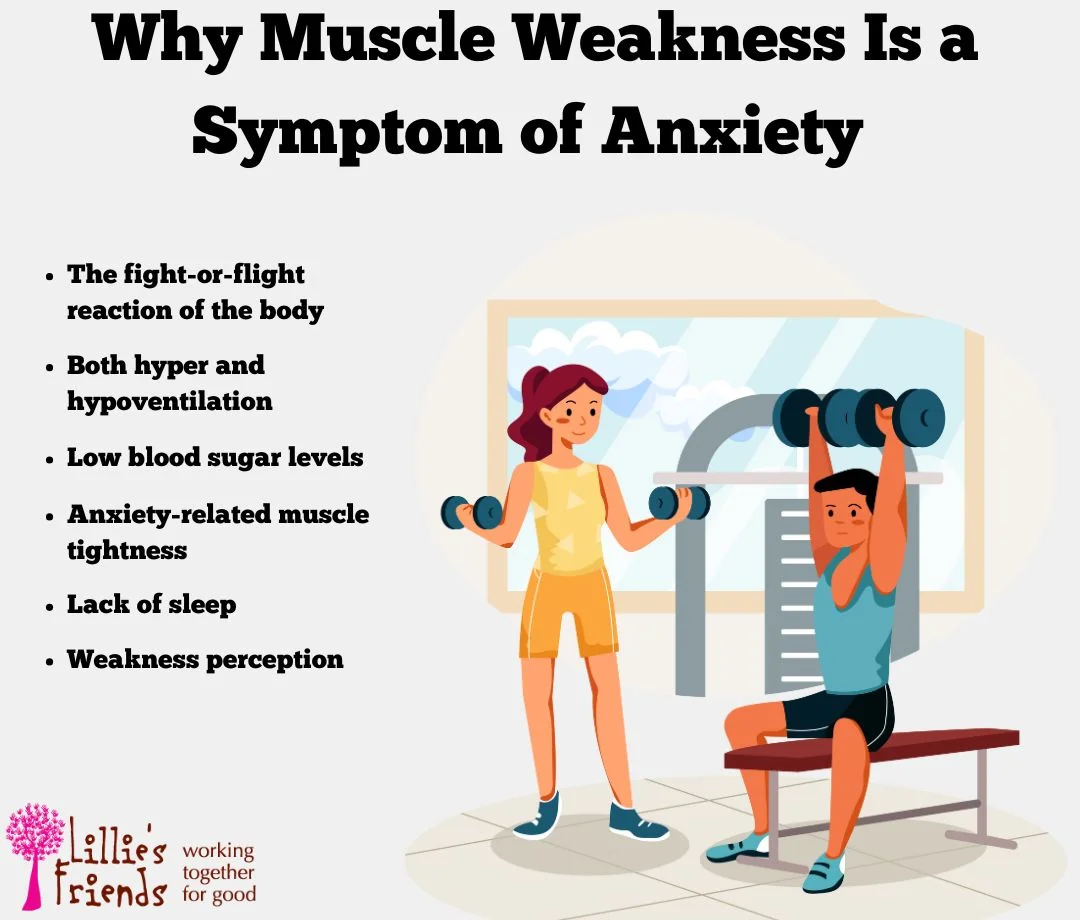
Anxiety-related muscular weakness can be caused by various circumstances. It can cause actual muscular weakening as well as the “feeling” of muscle weakness. The following are the most common causes of symptoms of muscular weakness brought on by anxiety:
Try these self-help techniques to lessen the sensation of having weak muscles if you are not truly and adequately exhausted:
If none of the aforementioned relieves your muscular weakness, a mental health professional’s guidance on anxiety therapy will be beneficial. Any of the following choices, or a combination of them, may be presented to you:
Is it possible for anxiety to result in muscular weakness? Indeed, it may, particularly during times of extreme worry and persistent anxiety. To properly manage and eliminate the symptoms, try to identify the underlying reasons.
If you adhere to your treatment plan, anxiety-related muscular weakness can be avoided.